
“I think we might have product-market fit” is one of the most common things founders say to me, usually followed by a pause that tells me they’re not actually sure. That uncertainty is itself useful information. Real PMF doesn’t usually feel ambiguous once you have it. Here’s what to check before you believe you’re there.
1. Every customer came through a personal favor
Trace your logo list back to its actual source. If every single one is a warm intro, a former colleague, or someone who took the meeting because they like you personally, that’s founder relationship strength, not product pull. Real PMF starts showing up as inbound interest from people who have never met you, because someone else told them about it unprompted.
2. You’re still writing a different pitch every time
If the core narrative changes meaningfully from one prospect to the next, not the examples or the emphasis, but the actual value proposition, that usually means you haven’t yet found the version of the story that consistently lands. A stable pitch that just gets refined at the edges is a good sign. A pitch that gets rewritten every few weeks is a sign you’re still searching.
3. Nobody’s upset when it’s gone
This is the one founders avoid checking because the answer is uncomfortable. If your product went down for a day, or a customer’s trial quietly expired, would anyone actually complain? Real usage creates real dependency. If usage is polite and passive, and churn happens quietly without a fight, that’s a signal the product hasn’t become load-bearing in anyone’s workflow yet.
4. You’re winning on price or relationship, not capability
Look at your last five wins and ask honestly why each one actually happened. If the answer is mostly “we gave a steep discount” or “the champion was a friend,” that’s not the same as winning because you’re clearly the best option for the problem. Deals won on capability tend to survive price pressure. Deals won on relationship or discount usually don’t.
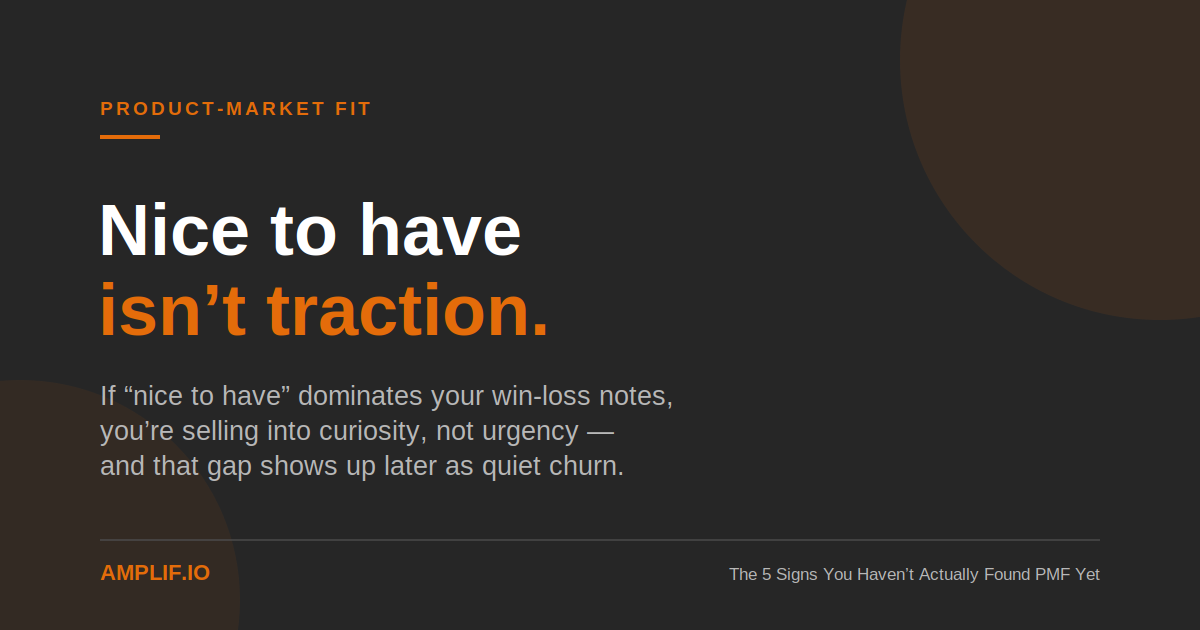
5. “Nice to have” shows up constantly in your notes
Go back through your call notes and win-loss reviews and actually count the language. “This would be nice to have” and “we need this now” are not the same signal, even when both eventually turn into a closed deal. If “nice to have” dominates, you’re probably early, selling into curiosity rather than urgency, and that gap tends to show up later as slow expansion and quiet churn.
None of these five signs alone is disqualifying. Most early-stage companies will see at least one or two, and that’s normal. What matters is the pattern. If most of these look familiar, the honest move isn’t to push harder on sales execution, it’s to go back and dig into why, before spending real money assuming the machine just needs to run faster.
For more on separating a go-to-market problem from an actual PMF problem, see Part 3 of our fractional GTM series.